 The reaction to Mitch Landrieu’s edict to take down the statues of Confederate generals in New Orleans has been as loud as it was predictable. Clearly, no respectable American can give any legitimate, sane defense for retaining these monuments and still be considered someone with whom you can be safely seen in public. Clearly.
I wish I could say that it’s only secularists and the modern political front runners and attention seekers who are doing this, but, alas, even evangelical Christians are rushing to get on the “right side of history” – with all the “respect” that affords (and we all know that nothing is more important than getting the respect of our modern arbiters of truth, beauty, and righteousness).
And I could respect this in some measure if it weren’t so easy to attain. All it takes is the willingness to learn the habit of selective indignation. Selective indignation is the ability to be outraged over the “sins” of those who are clearly out of favor with the ruling class while overlooking the same “sins” of those who are in favor with that group. Learn this and respect is all yours! It may be a bit more difficult than falling off a log, but it’s not as hard as it sounds.
So, in response to Mayor LAndrieu’s edict to remove the statue of Robert E. Lee, we hear cheers and very righteous endorsements from all the hip coolsters who know which way society’s winds are blowing. “We can’t defend anyone who fought to continue slavery!” “How dare you try to re-write history and make these men honorable?” “They fought for the Confederacy! They were all racists and rebels!” “To defend these men is equivalent to defending Nazis and the KKK and no one but blind bigots and liars are fools enough to do that!”
And on and on, until we get to the point where we can finish all their sentences.
But what if I told you that Abraham Lincoln believed blacks were inferior (by nature) to whites? What if I told you that Robert E. Lee freed more slaves than the Great Emancipator? What if I pointed to the fact that Lincoln plainly stated, more than once, that he thought the best solution for slavery was to ship all the African slaves back to Africa so that America could be what America (in his mind) was intended to be: a white/European country? What if you learned that Ole Abe was not an Abolitionist?
What then?
Here’s the oddity: In spite of the fact that all of the above statements are absolutely true (and well known to everyone who is familiar with Mr. Lincoln), we have yet to hear any demands that all the statues of Lincoln come down forthwith. There have been no denunciations of our Great Liberator. No demonstrations against his overt hypocrisy. No outrage. No editorials. Not even, heaven help us, a single blog post.
Why this response? Admire, dear friends, the work of selective indignation.
But at bottom, it’s just plain ole hypocrisy. The same old game that the self-righteous have been playing since Cain got insulted over the Lord’s inquiry about his brother’s whereabouts. “How dare you challenge our integrity? We’re on the right side here, not you. Your side lost. You’re a racist, ignorant bigot and we’re not. Our hands are pure, yours are dirty. How dare you defend what we condemn?”
Right. Got it.
 So, let’s see if we understand the rules here: We’re not allowed to point out that it was the North that practiced the truly damnable slave trade – and practiced it up through the beginning of the War? We’re not allowed to observe that slave owners in the North did not free their slaves but sold them for profit (and then condemned the buyers for being money-grubbing, immoral, heartless, man-stealers)? We’re not allowed to point out that the Confederate Constitution was the only modern constitution to outlaw the slave trade? We’re not allowed to observe that the Emancipation Proclamation was a merely a cheap piece of political maneuvering – that it did not free a single slave and was never designed to do so? That the Proclamation’s true message was not that one human being cannot justly own another, but that he cannot own another unless he is loyal to the United States?
Your rule is that Southerners are not allowed to re-write history – and we happily agree with that – but the rule also says it’s ok for the Northerners to do so.
And lastly the new rule is that if you have offended any of our new standards of morality and truth, you are not allowed to be honored – and if you happen to be honored, we have the right to demand that all honor be stripped away and stripped away with our fresh condemnations poured on with ladles of piping-hot disgust.
Of course, if sinless perfection is required before we give honor then everything must be damned. Nothing and no one is, nor ever can be, worthy of honor. And if we point out that God Himself honors flawed and sinful men (even those who owned slaves!) then He too, must be damned along with all those who agree with Him.
The new directive is that there must be no mercy shown, no concern for true justice, and no need for walking humbly before God or man or the neighbor’s bulldog. Our sensibilities are the new standards of holiness and righteousness and all who refuse to acknowledge our superiority must go to directly to Hell – and the sooner the better.
Jesus reminded us that we will face the same standards of judgment that we apply to others. So, what will future generations say of all our condemnations of the honorable men of the past when we presided over the period in which the greatest legal mass murder in the history of the world occurred?
But to return to our point: We are having the hardest time taking your condemnations seriously. Hypocrisy has that effect upon us – out of date and old fashioned as we are. But until we hear demands for the dismantling of the Lincoln memorial from you and your sweet friends, we will be forced to continue to assume that your concerns for justice, compassion, and mercy, are nothing more than play-acting – political posturing – an effort to win the approval of our self-appointed guardians of “righteousness and truth” and gather some scraps of precious “respect” from those who condemn the rest of us.
And in this effort, we can do nothing more than simply (and sadly) wish you the best. It’s a tough crowd to please and you’re gonna need all the help you can get.
Oh, and we gladly give up our seats on the “right-side-of-history” train. They’re all yours. But we need to warn you – that train ain’t going where you think it’s going.
 Protestants generally have paid little attention to the lesser feast days that have been set aside by the Church – and for the most part, we have done so for very sound reasons. But there are some feast days that it might be well for us to remember and commemorate – and one of these is today, the Feast of the Incarnation (or Feast of the Annunciation).
 Our elders have called for a time of congregational prayer and fasting tomorrow, the eve Independence Day, and we invite you all to join us. Fasting, however, is not something that we are all that familiar with and for that reason, I’ve made up a very brief primer on fasting to assist the members of our congregation. Much more could be said of course, but if you fast, please remember these things:
 RESURRECTION.
 CRUCIFYING
 The following appeared on the
  Dear John,
 Again, what shall we do with the Flood account? We are told precisely what day the Flood began (Gen. 7:6,11) which was, according to the biblical genealogies, in the 1656th year of the world. And we are told how long the waters “prevailed” upon the earth and the extent of this terrible judgment.
 One of the chief goals of the Westminster Assembly was to produce a confessional statement which the majority of evangelicals of the British Isles could endorse and upon which they could stand together. This was a much more daunting task than many today might realize.
 If loyalty to a confessional statement supplants faithfulness to the Scriptures (or if loyalty to a confession is identified with faithfulness to the Scriptures), we have fallen away from the Reformed tradition. Indeed, we are, at that point, in danger of departing from Jesus Himself and identifying with His enemies.
 In spite of the Westminster Assembly’s warning that the Scriptures are “the supreme judge by which all controversies of religion are to be determined, and all decrees of councils, opinions of ancient writers, doctrines of men, and private spirits, are to be examined,” and its caution that “All synods or councils, since the Apostles’ times, whether general or particular, may err; and many have erred. Therefore they are not to be made the rule of faith, or practice; but to be used as a help in both,” we see all around us, those who act as if the Westminster Confession is infallible and the standard of orthodoxy.
 But they were also keenly aware of other realities which stood as barriers against absolutizing confessions and creeds. The first of which is the influence of the historical situation upon theology (i.e. all theology is historically conditioned, i.e. molded and formed in the light of the peculiar historical circumstances in which theologians live). This is always the case no matter what the creed or confession or the giftedness of the authors. John Murray writes:
 It’s been a while coming but finally the new printing of The Federal Vision is at the printers and will be arriving in bookstores soon.
 Singing with vigor and joyful abandon has always been one of the things we’ve tried to emphasize over the years. I’m usually especially rabid about it after going on vacation, having visited churches where all you can hear is the piano (or organ) playing and a few weak voices here and there in the congregation like night thieves sneaking around afraid of waking someone.
 RESURRECTION.
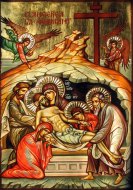 SEPULCHRE.
  CRUCIFYING
 THE AVENUE